Cloud Native C17
Building a WASM Serverless Solution with KEDA HTTP Add-on and Slight Containerd Shim
In this dispatch 10 sections
Introduction
In this article, we will explore how to use KEDA, the KEDA HTTP add-on, and Slight Containerd Shim to build a WASM serverless solution. The solution provides scale-to/from-zero support, reduced cold-start time, and cloud integration capabilities such as Azure Blob, App Configuration, Service Bus, and more. The diagram below shows how it works.
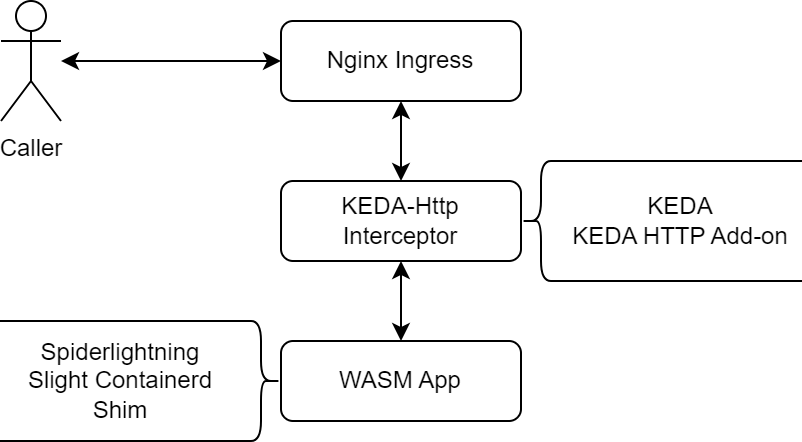
- Incoming HTTP requests are routed through Nginx Ingress Controller to the KEDA HTTP interceptor. The interceptor tracks pending requests, including requests waiting for the app to start and requests awaiting a response.
- The KEDA HTTP add-on operator runs inside the Kubernetes cluster, watches for HTTPScaledObject resources, and creates a ScaledObject for the Deployment specified in the HTTPScaledObject resource.
- ScaledObject points to the interceptor as the KEDA external scaler and uses gRPC to get the size of the pending queue. Based on this queue size, it reports scaling metrics to KEDA. As the queue size increases, the scaler instructs KEDA to scale up as appropriate.
- KEDA manages 0<->1 scaling and leverages HPA for 1 <-> n scaling.
- Kubernetes watches for WASM Pods being created, notices that their runtime is wasmtime-slight-v1, and leverages the Slight containerd shim to start the SpiderLightning host runtime for the WASM application.
- The WASM application receives the HTTP request and replies back.
Before jumping into the implementation, let’s take a closer look at the components used in the solution.
WASM
WebAssembly (WASM) is an open standard that defines a portable binary-code format for executable programs. It is designed as a portable compilation target for programming languages, enabling deployment on the web for client and server applications.
WASM allows serverless applications to be faster and more efficient. WASM enables the deployment of scripts and programs that can run on the serverless environment with fewer resources than traditional scripting languages. This makes serverless applications more cost-effective, as well as faster and more reliable. Additionally, using WASM to develop serverless applications allows for easier portability and integration with different platforms.
The Open Container Initiative (OCI) provides support for packaging a WASM application into a container image. Generally speaking, a minimal WASM container image is typically a few hundred kilobytes in size. For example, a sample WASM container image used in this solution is only 64.7KB.
IMAGE TAG IMAGE ID SIZE
…
ghcr.io/huangyingting/rust-slight main 8ce9ccccf9eea 64.7kB
…
KEDA and KEDA HTTP Add-on
KEDA is a Kubernetes-based Event Driven Autoscaler. With KEDA, you can drive the scaling of any container in Kubernetes based on the number of events needing to be processed.
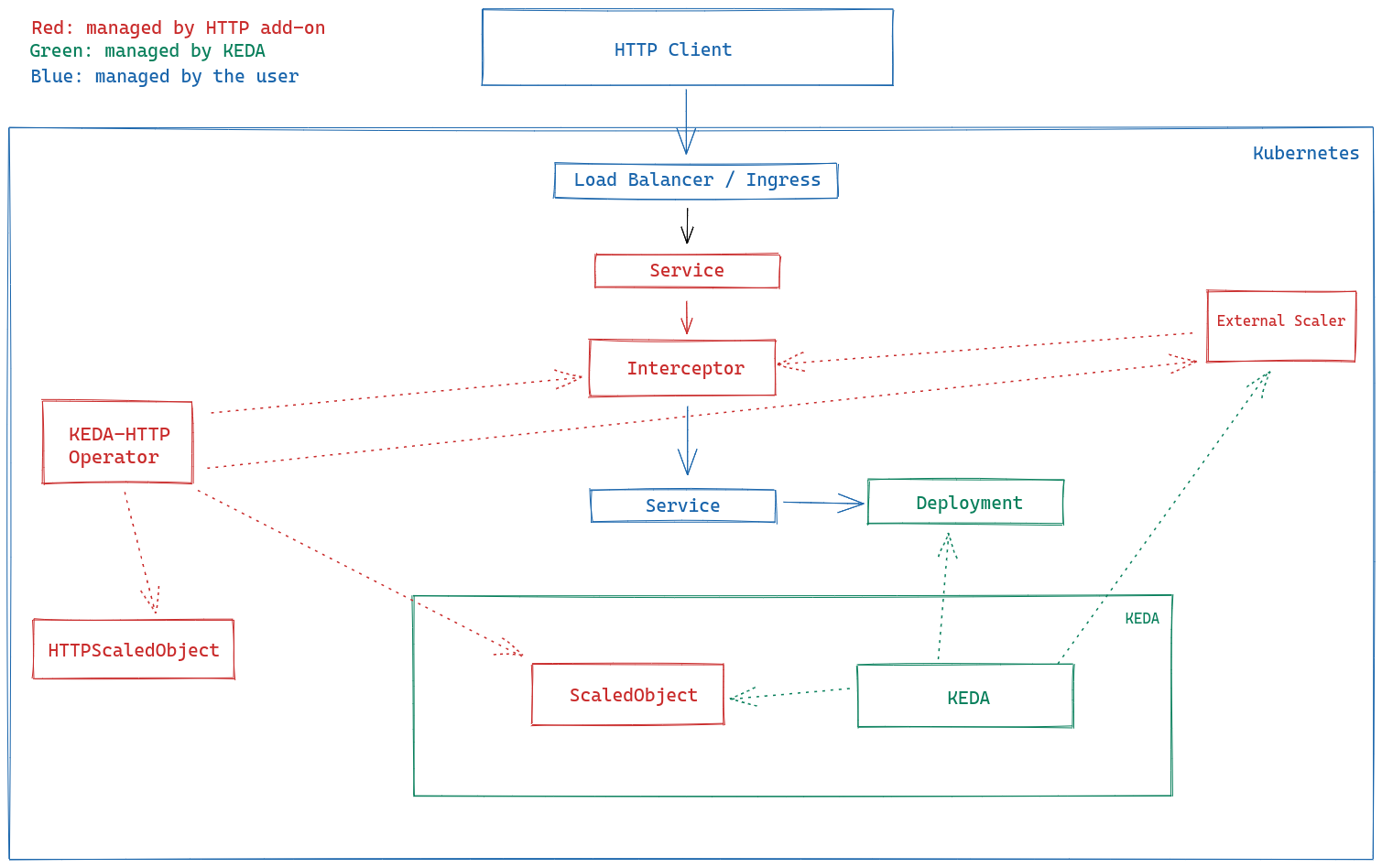
KEDA provides a reliable and well-tested solution for scaling your workloads based on external events. However, KEDA doesn’t provide an HTTP-based scaler. The KEDA HTTP Add-on allows Kubernetes users to automatically scale their HTTP servers up and down (including to/from zero) based on incoming HTTP traffic. The diagram below is copied from the KEDA HTTP Add-on design page and shows how it works.
SpiderLightning and Slight Containerd Shim
SpiderLightning (Slight) is an open source WASM host (based on WasmTime) for building and running fast, secure, and composable cloud microservices with WebAssembly. It defines a set of WebAssembly Interface Types (i.e., WIT) files that abstract distributed application capabilities, such as state management, pub/sub, event-driven programming, and more.
Slight Containerd Shim is a containerd shim powered by the SpiderLightning engine. It allows you to run WASM applications developed with SpiderLightning SDKs (C and Rust are currently supported).
Implementation
The solution implementation requires deploying several components, including:
- Slight Containerd Shim
- Nginx Ingress Controller
- KEDA and KEDA HTTP add-on
- Redis - used by demo application to illustrate SpiderLightning capabilities
- Sample application and manifests
The detailed steps are below.
Install Slight Containerd Shim
Refer to “Deis Labs Containerd Wasm Shims” section from my previous article Run WASM applications from Kubernetes
Deploy Nginx Ingress Controller
helm repo add ingress-nginx https://kubernetes.github.io/ingress-nginx
helm repo update
helm install ingress-nginx ingress-nginx/ingress-nginx
Deploy KEDA and KEDA HTTP add-on
Deploy KEDA
helm repo add kedacore https://kedacore.github.io/charts
helm repo update
kubectl create namespace keda
helm install keda kedacore/keda --namespace keda
Deploy KEDA HTTP add-on
helm install http-add-on kedacore/keda-add-ons-http --namespace kedaDeploy Redis
 helm repo add bitnami https://charts.bitnami.com/bitnami
 helm repo update
 helm install redis bitnami/redis
Sample Application and Manifests
A sample WASM application is created to read/write/delete Redis cache. The source code is located in this repo.
To deploy this application, follow these steps:
- Generate a YAML file with the content below. Replace
REPLACE_IT_WITH_REDIS_ADDRESSwith the Redis address. If you followed the Redis deployment step above, the Redis address will generally be redis://redis-master.redis:6379. ReplaceREPLACE_IT_WITH_FQDNwith an FQDN name for external access, for example, rust-slight.yourdomain.com.
apiVersion: v1
kind: Namespace
metadata:
  name: rust-slight
---
apiVersion: apps/v1
kind: Deployment
metadata:
  name: rust-slight
  namespace: rust-slight
spec:
  replicas: 1
  selector:
    matchLabels:
      app: rust-slight
  template:
    metadata:
      labels:
        app: rust-slight
    spec:
      runtimeClassName: wasmtime-slight
      containers:
        - name: rust-slight
          image: ghcr.io/huangyingting/rust-slight:main
          imagePullPolicy: IfNotPresent
          command: ["/"]
          env:
          - name: REDIS_ADDRESS
            value: REPLACE_IT_WITH_REDIS_ADDRESS
---
apiVersion: v1
kind: Service
metadata:
  name: rust-slight
  namespace: rust-slight
spec:
  type: ClusterIP
  ports:
    - protocol: TCP
      port: 3000
      targetPort: 3000
  selector:
    app: rust-slight
---
apiVersion: networking.k8s.io/v1
kind: Ingress
metadata:
  name: rust-slight
  namespace: keda
  annotations:
    nginx.ingress.kubernetes.io/rewrite-target: /
spec:
  ingressClassName: nginx
  rules:
  - host: REPLACE_IT_WITH_FQDN
    http:
      paths:
      - path: /
        pathType: Prefix
        backend:
          service:
            name: keda-add-ons-http-interceptor-proxy
            port:
              number: 8080
---
kind: HTTPScaledObject
apiVersion: http.keda.sh/v1alpha1
metadata:
    name: rust-slight
    namespace: rust-slight
spec:
    host: REPLACE_IT_WITH_FQDN
    targetPendingRequests: 200
    scaleTargetRef:
        deployment: rust-slight
        service: rust-slight
        port: 3000
    replicas:
        min: 0
max: 10- Run
kubectl apply -f manifest.yamlto deploy the application - Notice the application is scaled to 0 as currently there is no HTTP request
kubectl get deploy -n rust-slight
NAME          READY   UP-TO-DATE   AVAILABLE   AGE
rust-slight 0/0 0 0 34s- Send an HTTP request to see what happens
curl http://rust-slight.yourdomain.com/read- After 1 or 2 seconds, our WASM application echoes HTTP request back
user-agent: curl/7.81.0
accept: */*
x-forwarded-for: X.X.X.X, 192.168.2.19
x-forwarded-host: rust-slight.yourdomain.com
x-forwarded-port: 80
x-forwarded-proto: http
x-forwarded-scheme: http
x-real-ip: X.X.X.X
x-request-id: 6ccba5facab304b26cbb129b92fca9f6
x-scheme: http
accept-encoding: gzip- Check deployment again, it is scaled out to 1
kubectl get deploy -n rust-slight
NAME          READY   UP-TO-DATE   AVAILABLE   AGE
rust-slight 1/1 1 1 2s- The application supports Redis reads, writes, and deletes. Here are some sample commands to try:
# Write
curl -X PUT -d '{"key": "version", "value": "1.0.0"}' http://rust-slight.yourdomain.com/create
# Update
curl -X POST -d '{"key": "version", "value": "1.0.1"}' http://rust-slight.yourdomain.com/update
# Delete
curl -X DELETE -d '{"key": "version"}' http://rust-slight.yourdomain.com/delete
# Read
curl http://rust-slight.yourdomain.com/read