Field Notes D10
GitHub Copilot Model Token Speed Benchmark: Decomposing Latency, Verbosity, and Throughput Across 28 Hosted Models
An empirical analysis of 280 sequential benchmark runs across 28 GitHub Copilot-hosted models and 10 scenarios — separating the 8–14s first-token prefill floor from true marginal token streaming speed, verbosity bias, reasoning effort overhead, and polyglot coding performance.
Part of AI Coding Systems
In this dispatch 18 sections
With GitHub Copilot now hosting more than two dozen foundation models from Anthropic, OpenAI, Google, xAI, and Microsoft behind a unified gateway, how fast is each hosted model in practice — and why does a model with a higher tok/s rating sometimes take twice as long to finish a coding task as a model ranked ten places below it?
To answer that with real telemetry rather than vendor spec sheets, I ran an end-to-end benchmark across 28 GitHub Copilot-hosted models and 10 scenarios (280 sequential runs total, with 276/280 succeeding). The suite spans six model families hosted by GitHub Copilot as of October 2026:
- Anthropic Claude (8 models):
claude-haiku-4.5,claude-haiku-5.5,claude-sonnet-5,claude-sonnet-5.5,claude-opus-4.8,claude-opus-5,claude-opus-5.5, andclaude-fable-5. - OpenAI GPT-5 & GPT-6 (12 models):
gpt-5-mini,gpt-5.3-codex,gpt-5.4,gpt-5.4-mini,gpt-5.5,gpt-5.6-luna,gpt-5.6-sol,gpt-5.6-terra,gpt-6-astra,gpt-6-luna,gpt-6-sol, andgpt-6.1-sol. - Google Gemini (3 models):
gemini-3.7-flash,gemini-3.8-flash, andgemini-4-argon. - xAI Grok (3 models):
grok-4.5,grok-4.6, andgrok-4.7. - Microsoft MAI (1 model):
mai-code-1.1-flash. - Copilot Dynamic Router (1 target):
auto.
Look at a standard one-dimensional bar chart of tok/s and you will walk away with only half the story. In an end-to-end request against a Copilot-hosted model, observed token speed is a composite ratio governed by three coupled forces: a fixed 7.7–13.7 second gateway + prefill latency floor, the post-prefill streaming velocity of the model backend, and the model’s output verbosity. Once you separate those three dimensions using phase-space contours, bipartite slopegraphs, and marginal latency decomposition, the benchmark tells a much sharper engineering story.
1. Measurement Methodology & The End-to-End Throughput Equation
To probe every Copilot-hosted model through the exact same client path, each cell in the benchmark executes a fresh one-shot request (copilot -p "<scenario_prompt>" --model <M> -s) and measures the full request lifecycle:
- Wall-clock time (
T_total): Total elapsed seconds from request initiation to completion. - Estimated output tokens (
N_tok): Approximated aschars / 4.
The reported end-to-end throughput (R_E2E) is therefore:
R_E2E = N_tok / T_total
      = N_tok / (T_floor + T_think + N_tok / v_stream)
where:
T_flooris the fixed per-request latency floor: client initialization, Copilot gateway authentication, system-prompt prefill, model routing, and time to first token (TTFT).T_thinkis the unprinted reasoning time (for reasoning models that generate hidden chain-of-thought tokens before emitting visible text).v_streamis the true marginal token decoding speed once visible tokens begin streaming.
This single equation explains three counterintuitive phenomena that show up across the 280 runs:
- Short answers are 100% latency-bound: When
N_tok = 1(the 1-word scenario),R_E2E ≈ 1 / T_floor, compressing every model into0.07–0.13 tok/s. - Verbosity inflates end-to-end
tok/s: BecauseT_flooris a fixed ~8–10 second overhead paid once per request, a model that writes1,600tokens of heavily commented code amortizesT_floorover a much larger numerator than a terse model that solves the same problem in450tokens. - Hidden thinking tokens depress visible
tok/s: On logic puzzles, models spend wall-clock time generating internal reasoning tokens that are never returned in the final text, makingN_tok / T_totaldrop to1–8 tok/s.
2. The Speed–Verbosity Phase Space: Why High tok/s Does Not Always Mean Fast Code
A conventional horizontal bar chart ranks claude-opus-5 (49.3 tok/s) fourth overall on coding tasks — far ahead of gpt-5.6-luna (34.3 tok/s, ranked 18th) and gpt-6-luna (35.7 tok/s, ranked 16th). Yet if you wait for those six coding tasks to finish, gpt-5.6-luna completes in 13.42 seconds on average, whereas claude-opus-5 takes 32.19 seconds — the slowest wall-clock coding time of all 28 hosted models.
Instead of a single bar chart, plotting Mean Coding Wall-Clock Time (T) on the horizontal axis against Mean Coding Throughput (R_E2E) on the vertical axis maps every model into a 2D Speed–Verbosity Phase Space. Because N_tok ≈ R_E2E × T, curves of constant token output form diagonal iso-token contours across the chart, while bubble area encodes mean output token volume.
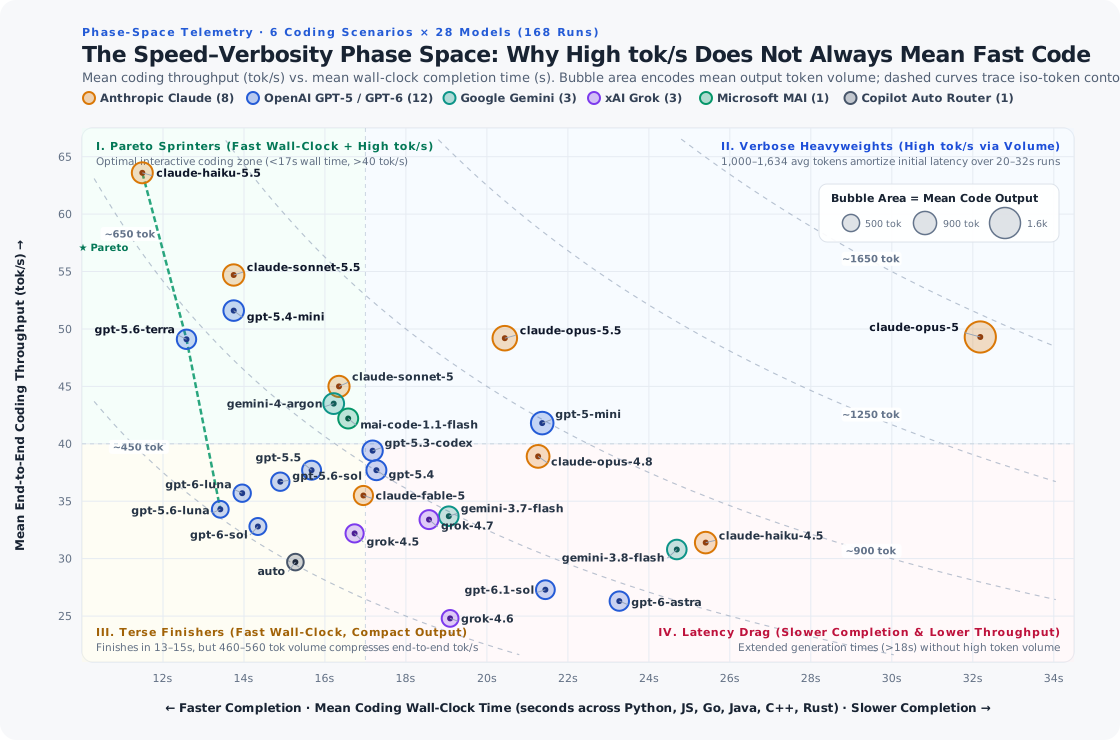
Splitting the phase space at the benchmark medians (17.0s wall-clock time and 40.0 tok/s throughput) divides the 28 models into four distinct operational quadrants:
Quadrant I: The Pareto Sprinters (<17s wall time, >40 tok/s)
These seven models deliver both rapid wall-clock completion and high token generation velocity:
| Model | Coding Avg Throughput (tok/s) | Coding Mean Wall Time (s) | Coding Mean Output (tok) | Long Prose Throughput (tok/s) | Operational Profile |
|---|---|---|---|---|---|
claude-haiku-5.5 | 63.6 | 11.49 | 744 | 62.49 | Overall Pareto leader: fastest wall-clock coding time and highest coding tok/s |
claude-sonnet-5.5 | 54.7 | 13.75 | 761 | 56.67 | Frontier-grade code quality at near-Haiku wall-clock latency |
gpt-5.4-mini | 51.6 | 13.75 | 705 | 68.65 | Tied for 3rd-fastest wall-clock coding time (13.75s) with 300+ tok/s burst decode |
gpt-5.6-terra | 49.1 | 12.58 | 634 | 49.03 | 2nd-fastest wall-clock coder (12.58s); rock-steady 49.1 tok/s across prose and code |
claude-sonnet-5 | 45.0 | 16.35 | 747 | 45.33 | Balanced mid-tier throughput across both prose and code |
gemini-4-argon | 43.5 | 16.22 | 723 | 53.46 | Fastest Google model across both coding (43.5 tok/s) and prose (53.46 tok/s) |
mai-code-1.1-flash | 42.2 | 16.57 | 667 | 69.42 | #1 in long prose (12.14s), dragged to 16.57s coding mean by a 30.45s Rust run |
Together, claude-haiku-5.5, gpt-5.6-terra, and gpt-5.6-luna define the empirical Pareto frontier: no other model in the 28-model pool finishes faster in wall-clock time while achieving higher throughput.
Quadrant II: The Verbose Heavyweights (>20s wall time, >40 tok/s)
claude-opus-5(49.3 tok/s,32.19smean time,1,634mean tokens): Emits 2.2× to 3.5× more tokens per coding prompt than the rest of the field (1,782tokens in Python,1,623in JavaScript,2,701in Rust). Because its8.02sstartup floor is amortized across1,634tokens, its end-to-endtok/slooks deceptively fast (49.3 tok/s) even though a user waits half a minute per response.claude-opus-5.5(49.2 tok/s,20.44smean time,1,015mean tokens): A major generational improvement over Opus 5 — it preserves the exact same49.2 tok/sthroughput while reigning in verbosity by 38%, shaving 11.75 seconds off average coding wait time.gpt-5-mini(41.8 tok/s,21.37smean time,856mean tokens): High token volume keeps itstok/sabove41, but long wall-clock runs in JavaScript (26.09s) and Rust (32.54s) push it into the slower half of the chart.
Quadrant III: The Terse Finishers (13.4s–16.9s wall time, <40 tok/s)
Models in the bottom-left quadrant are much faster in practice than their tok/s ranking implies:
gpt-5.6-luna(13.42s,476tok,34.3 tok/s) andgpt-6-luna(13.96s,512tok,35.7 tok/s) finish coding tasks faster than 24 of the 28 models tested.gpt-6-sol(14.34s,481tok,32.8 tok/s),gpt-5.6-sol(14.90s,561tok,36.7 tok/s), andauto(15.27s,466tok,29.7 tok/s) all complete average coding tasks in under15.5seconds.- Their
tok/snumbers look modest only because they emit compact, minimal-prose code blocks (466–561tokens) where the ~9–14s initial prefill floor accounts for 60% to 75% of total wall-clock time.
Quadrant IV: Latency Drag (>18s wall time, <39 tok/s)
In the bottom-right quadrant, models suffer from genuine generation latency without compensating verbosity: gpt-6-astra (23.27s, 26.3 tok/s), gpt-6.1-sol (21.44s, 27.3 tok/s), grok-4.6 (19.09s, 24.8 tok/s), claude-haiku-4.5 (25.41s, 31.4 tok/s), and gemini-3.8-flash (24.69s, 30.8 tok/s, heavily skewed by 34.35s in Go and 51.36s in Rust).
3. Decomposing the First-Token Floor, Marginal Streaming Speed, and Reasoning Effort
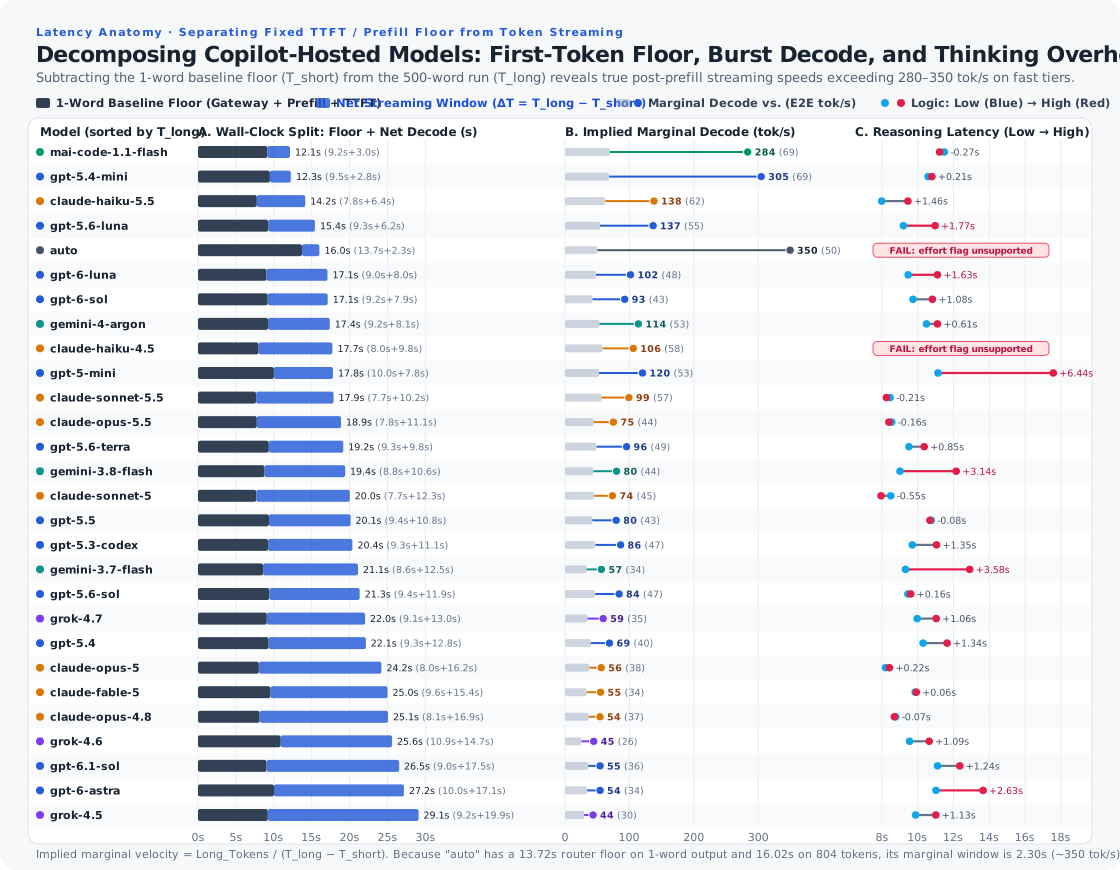
How much of a request to a Copilot-hosted model is spent waiting for gateway routing and prompt prefill versus actually streaming tokens? Because the benchmark includes both a 1-word scenario (short, N_tok = 1) and a 500-word prose scenario (long, N_tok between 655 and 1,035) at default reasoning effort, we can use T_short as an empirical proxy for the fixed first-token floor (T_floor) and isolate the net streaming window:
ΔT_stream  = T_long - T_short
v_marginal = (N_long - 1) / (T_long - T_short)
The three-panel telemetry chart below pairs this two-stage wall-clock split (Panel A) with the implied post-prefill streaming velocity (Panel B) and the logic-puzzle reasoning effort barbell (Panel C).
A. The 7.67s–13.72s Gateway & Prefill Floor
Across all 28 hosted models, generating a single one-word response (1 token) never takes less than 7.67 seconds — and the baseline floor clusters tightly by provider backend:
- Anthropic Claude 5 / 5.5 tier (
7.67s – 8.13s):claude-sonnet-5.5(7.67s),claude-sonnet-5(7.69s),claude-haiku-5.5(7.76s),claude-opus-5.5(7.76s),claude-haiku-4.5(7.98s),claude-opus-5(8.02s), andclaude-opus-4.8(8.13s) have the lowest first-token floor among all Copilot-hosted endpoints (claude-fable-5is the lone exception at9.56s). - Google Gemini tier (
8.59s – 9.23s):gemini-3.7-flash(8.59s),gemini-3.8-flash(8.77s), andgemini-4-argon(9.23s). - OpenAI GPT-5 / GPT-6 & Microsoft MAI tier (
9.03s – 10.02s): Nearly every GPT model lands in a narrow9.03s–9.49sband (gpt-6-lunaandgpt-6.1-solat9.03s,mai-code-1.1-flashat9.17s,gpt-5-miniat10.01s,gpt-6-astraat10.02s). - Copilot
autorouter (13.72s): Targetingautoadds 4.5 to 6.0 seconds of routing overhead on a one-word prompt compared to specifying a concrete model ID.
B. Burst Streaming: 280–350 tok/s Behind the Prefill Curtain
Once T_short is subtracted from T_long, the marginal time required to stream ~840 tokens of prose reveals a dramatic separation between ultra-fast flash/mini decoders and standard frontier decoders:
auto(13.72sfloor +2.30snet window for804tokens →~350 tok/smarginal): Despite having the slowest 1-word floor (13.72s),autocompletes an 804-token essay in16.02stotal — meaning that once the router selects a backend for the prose prompt, the underlying model streams 803 tokens in just 2.30 seconds.gpt-5.4-mini(9.49sfloor +2.76snet window for841tokens →~305 tok/smarginal): Generates 840 additional tokens in2.76s, achieving68.65 tok/send-to-end.mai-code-1.1-flash(9.17sfloor +2.97snet window for843tokens →~284 tok/smarginal): Finishes the 500-word generation in 12.14 seconds (69.42 tok/send-to-end, #1 overall).- Next-tier fast streamers (
100–140 tok/smarginal):claude-haiku-5.5(138 tok/smarginal,6.40snet window),gpt-5.6-luna(137 tok/smarginal,6.15snet window),gpt-5-mini(120 tok/smarginal),gemini-4-argon(114 tok/smarginal),claude-haiku-4.5(106 tok/smarginal),gpt-6-luna(102 tok/smarginal), andclaude-sonnet-5.5(99 tok/smarginal).
C. Reasoning Effort (low vs. high) and the 4 Failed Runs
Scenarios 3 and 4 run a logic puzzle with explicit reasoning effort configuration (low vs. high). Three findings stand out in Panel C:
- Four runs failed due to unsupported reasoning-effort configuration: Both
autoandclaude-haiku-4.5rejected the configuration onreason_lowandreason_highwith:
If your harness or agent configuration passes reasoning-effort parameters globally, targetingError: Model "auto" does not support reasoning effort configuration (requested: "low" / "high"). Error: Model "claude-haiku-4.5" does not support reasoning effort configuration (requested: "low" / "high").autoorclaude-haiku-4.5will hard-fail the request. - Hidden thinking tokens make visible
tok/slook tiny (0.94–7.96 tok/s): Visible answers on the logic puzzle are only10 to 80 tokenslong, so total time reflects internal reasoning rather than output serialization. - Divergent sensitivity to
highvs.loweffort:- High thinking expansion:
gpt-5-minijumps from11.13s(low) to17.57s(high) (+6.44s),gemini-3.7-flashrises+3.58s(9.32s → 12.90s),gemini-3.8-flashrises+3.14s(9.01s → 12.15s), andgpt-6-astrarises+2.63s(11.02s → 13.65s). - Reasoning invariance on trivial logic: Anthropic’s
claude-sonnet-5.5(8.46s → 8.25s),claude-opus-5.5(8.55s → 8.39s),claude-sonnet-5(8.50s → 7.95s), andclaude-opus-4.8(8.77s → 8.70s) solve the puzzle in ~8.0–8.8s regardless of effort setting.
- High thinking expansion:
4. Regime Shift: Unconstrained Prose vs. Polyglot Code Generation
Does a model that tops the leaderboard on a 500-word essay stay on top when writing Python, JavaScript, Go, Java, C++, and Rust?
The bipartite Regime-Transition Slopegraph below connects each model’s rank and throughput on Long Prose (~500 words) (left axis) to its 6-Language Coding Average (right axis).
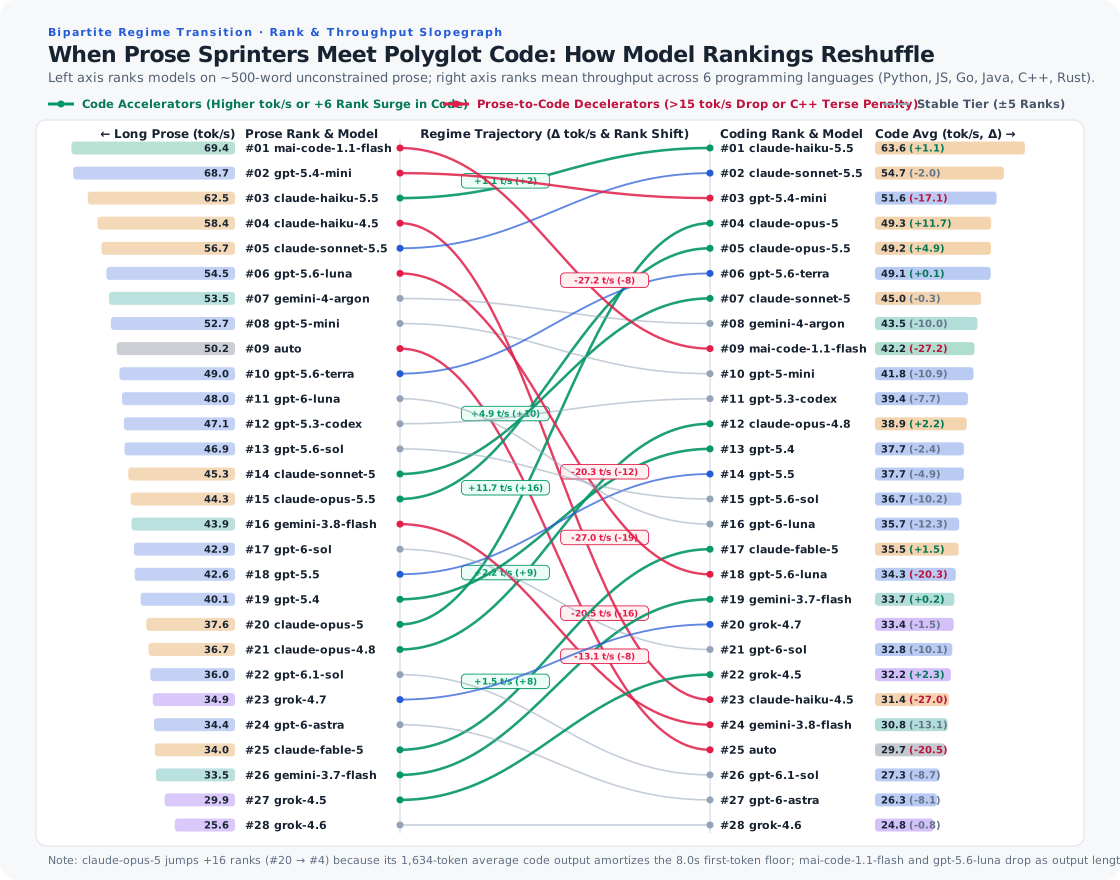
The slope trajectories expose a sharp bifurcation between Code Accelerators (green upward slopes) and Prose-to-Code Decelerators (red downward slopes):
- Anthropic’s Claude 5 / 5.5 family dominates the upward slopes:
claude-opus-5surges +16 ranks (#20in prose at37.62 tok/s→#4in code at49.3 tok/s,+11.7 tok/s), propelled by its1,634-token average code output.claude-opus-5.5climbs +10 ranks (#15at44.31 tok/s→#5at49.2 tok/s,+4.9 tok/s).claude-opus-4.8climbs +9 ranks (#21 → #12,+2.2 tok/s),claude-fable-5climbs +8 ranks (#25 → #17,+1.5 tok/s),claude-sonnet-5climbs +7 ranks (#14 → #7), andclaude-haiku-5.5rises +2 ranks (#3 → #1at63.6 tok/s).
- Flash/Mini prose leaders drop when code outputs contract or hit language outliers:
mai-code-1.1-flashdrops from#1(69.42 tok/s) to#9(42.2 tok/s,-27.2 tok/s), primarily because its Go (26.96 tok/s) and Rust (33.30 tok/s,30.45s) runs run slower than its prose burst.claude-haiku-4.5falls 19 ranks (#4at58.39 tok/s→#23at31.4 tok/s,-27.0 tok/s) as its wall-clock time stretches to23–32sacross every programming language.autodrops 16 ranks (#9at50.17 tok/s→#25at29.7 tok/s,-20.5 tok/s) because its coding outputs average only466 tokensagainst its heavy router startup floor.gpt-5.6-lunadrops 12 ranks (#6at54.55 tok/s→#18at34.3 tok/s,-20.3 tok/s), despite finishing code in13.42son average, because its C++ response was only37tokens (2.88 tok/s).
5. Polyglot Fingerprint: 28 Models × 10 Scenarios and Three Empirical Anomalies
To inspect every run without losing granularity to averages, the Polyglot Fingerprint Matrix below encodes all 280 cells simultaneously — pairing top column distribution summaries (μ throughput and token volume) with per-cell tok/s color intensity and (token count) annotations.
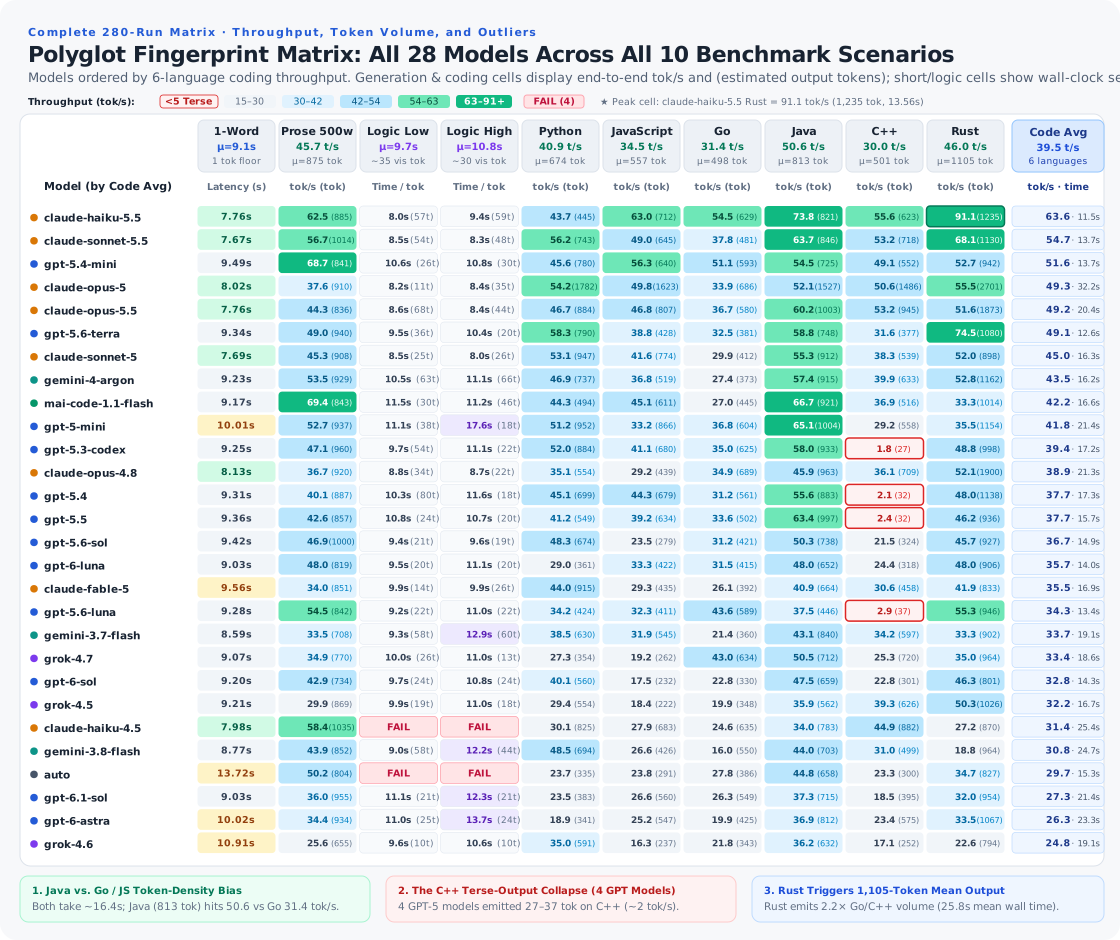
Aggregating across all 28 models by programming language reveals why language choice alone can swing your measured tok/s by more than 60%:
| Coding Scenario | Field Mean Throughput (tok/s) | Field Mean Wall Time (s) | Field Mean Output (tok) | Fastest Throughput Cell (tok/s) | Fastest Wall-Clock Cell (s) | Slowest Wall-Clock Cell (s) |
|---|---|---|---|---|---|---|
| Code: Python | 40.86 | 16.42 | 674 | gpt-5.6-terra (58.29) | claude-haiku-5.5 (10.19s) | claude-opus-5 (32.88s) |
| Code: JavaScript | 34.49 | 16.09 | 557 | claude-haiku-5.5 (62.96) | gpt-5.6-terra (11.04s) | claude-opus-5 (32.61s) |
| Code: Go | 31.37 | 16.61 | 498 | claude-haiku-5.5 (54.52) | claude-haiku-5.5 (11.54s) | gemini-3.8-flash (34.35s) |
| Code: Java | 50.61 | 16.38 | 813 | claude-haiku-5.5 (73.75) | claude-haiku-5.5 (11.13s) | claude-opus-5 (29.33s) |
| Code: C++ | 29.96 | 16.50 | 501 | claude-haiku-5.5 (55.61) | claude-haiku-5.5 (11.20s) | claude-opus-5 (29.39s) |
| Code: Rust | 45.95 | 25.83 | 1,105 | claude-haiku-5.5 (91.11) | claude-haiku-5.5 (13.56s) | gemini-3.8-flash (51.36s) |
Which Hosted Model Should You Use for Each Programming Language?
Because token density and completion behavior vary sharply across ecosystems, the matrix points to clear per-language model choices rather than a single one-size-fits-all default:
- Python: Use
gpt-5.6-terra(58.29 tok/s,13.55s) orclaude-sonnet-5.5(56.19 tok/s,13.22s) when you want complete, idiomatic implementations at top throughput, orclaude-haiku-5.5(10.19s) andmai-code-1.1-flash(11.15s) for the fastest sub-12-second turnaround. - JavaScript / TypeScript: Pick
claude-haiku-5.5(62.96 tok/s,11.31s) orgpt-5.4-mini(56.27 tok/s,11.37s) for rapid front-end and Node.js iteration, withgpt-5.6-terra(11.04s) andclaude-sonnet-5.5(48.95 tok/s,13.18s) as strong alternatives. - Go: Stick to
claude-haiku-5.5(54.52 tok/s,11.54s) orgpt-5.4-mini(51.15 tok/s,11.59s) — the only two models that break50 tok/sand finish under12seconds in Go — orgpt-5.6-luna(43.57 tok/s,13.52s); avoidgemini-3.8-flash, which stalls to34.35s(16.01 tok/s). - Java: Choose
claude-haiku-5.5(73.75 tok/s,11.13s),mai-code-1.1-flash(66.68 tok/s,13.81s), orclaude-sonnet-5.5(63.70 tok/s,13.28s), all of which stream through Java’s heavy class and type scaffolding at63–74 tok/swithout wall-clock drag. - C++: Prefer
claude-haiku-5.5(55.61 tok/s,11.20s),claude-sonnet-5.5(53.24 tok/s,13.49s),claude-opus-5.5(53.20 tok/s,17.76s), orgpt-5.4-mini(49.07 tok/s,11.25s), and avoidgpt-5.3-codex,gpt-5.4,gpt-5.5, andgpt-5.6-lunaon terse C++ prompts where they emitted truncated27–37token responses. - Rust: Default to
claude-haiku-5.5(91.11 tok/s,13.56s),gpt-5.6-terra(74.55 tok/s,14.49s), orclaude-sonnet-5.5(68.06 tok/s,16.60s); Rust’s1,105-token average output punishes slower or overly verbose models likegemini-3.8-flash(51.36s),claude-opus-5(48.67s), andclaude-opus-5.5(36.27s).
Three structural anomalies stand out across the matrix:
Anomaly 1: The Java vs. Go/JS Token-Density Illusion (16.4s for Both, 50.6 vs. 31.4 tok/s)
Look closely at the first five programming languages (Python, JavaScript, Go, Java, and C++). Their field-wide mean wall-clock completion times are virtually identical: 16.42s, 16.09s, 16.61s, 16.38s, and 16.50s — a spread of just 0.52 seconds!
Yet Java’s mean throughput is 50.61 tok/s while Go’s is 31.37 tok/s. Because Java syntax involves longer class/type identifiers and ceremony (813 average estimated tokens vs. Go’s 498 tokens), and because post-prefill streaming happens at 100–300 tok/s, generating an extra 315 tokens of Java boilerplate adds less than two seconds of decode time while boosting est_tokens / total_time by +61%.
Anomaly 2: The C++ Terse-Output Collapse on Four GPT-5 Models
In the Code: C++ column, four strong OpenAI models suddenly drop to red single-digit tok/s cells:
gpt-5.3-codex:27tokens in15.13s→1.78 tok/s(vs.35–58 tok/sin the other 5 languages)gpt-5.4:32tokens in15.24s→2.10 tok/s(vs.31–56 tok/sin the other 5 languages)gpt-5.5:32tokens in13.58s→2.36 tok/s(vs.34–63 tok/sin the other 5 languages)gpt-5.6-luna:37tokens in12.83s→2.88 tok/s(vs.32–55 tok/sin the other 5 languages)
These models did not stall on C++ — their wall-clock times (12.83s–15.24s) were actually faster than the 16.50s field average. Instead, they returned a bare ~110–150 character response (27–37 estimated tokens) without surrounding prose or full boilerplate. Because a single-run average across 6 languages weights each language equally, that one 30-token C++ cell drags their reported 6-language coding average down by 6.5 to 8.0 tok/s:
| Model | Reported 6-Lang Coding Avg (tok/s) | 5-Lang Coding Avg Excl. C++ Outlier (tok/s) | C++ Tokens (chars/4) | C++ Wall Time (s) |
|---|---|---|---|---|
gpt-5.3-codex | 39.4 | 46.98 | 27 | 15.13 |
gpt-5.4 | 37.7 | 44.84 | 32 | 15.24 |
gpt-5.5 | 37.7 | 44.71 | 32 | 13.58 |
gpt-5.6-luna | 34.3 | 40.56 | 37 | 12.83 |
Anomaly 3: The Rust Token Explosion (1,105 Avg Tokens, 91.11 tok/s Peak)
Rust is the only language where every model family generates substantially more text (1,105 tokens on average — more than double Go’s 498 and C++‘s 501 tokens) and takes 25.83s on average (+9.4s longer than the other five languages).
- On fast decoders, Rust’s large token payload fully dilutes the initial prefill floor, propelling
claude-haiku-5.5to91.11 tok/s(1,235tokens in13.56s— the single fastest throughput run in the entire 280-run dataset) andgpt-5.6-terrato74.55 tok/s(1,080tokens in14.49s). - On verbose or slower decoders, Rust triggers tail-latency spikes:
gemini-3.8-flashtakes51.36s(964tokens,18.77 tok/s),claude-opus-5takes48.67swhile emitting2,701tokens (55.50 tok/s), andclaude-opus-4.8takes36.44s(1,900tokens).
6. Complete 28-Model Benchmark Leaderboard & Reference Table
The table below consolidates all 28 models ordered by 6-Language Coding Throughput (tok/s), alongside their 1-word baseline floor, 500-word prose generation metrics, implied post-prefill streaming speed, and logic-puzzle reasoning latency:
| Rank (Code) | Model | Family | 1-Word Floor (s) | Long Prose (tok/s) | Long Time (s / tok) | Implied Marginal Stream (tok/s) | Coding Avg (tok/s) | Coding Mean Time (s / tok) | Logic Low → High (s) |
|---|---|---|---|---|---|---|---|---|---|
| 1 | claude-haiku-5.5 | Claude | 7.76 | 62.49 | 14.16s / 885 | ~138 | 63.6 | 11.49s / 744 | 7.99 → 9.45 |
| 2 | claude-sonnet-5.5 | Claude | 7.67 | 56.67 | 17.89s / 1014 | ~99 | 54.7 | 13.75s / 761 | 8.46 → 8.25 |
| 3 | gpt-5.4-mini | GPT | 9.49 | 68.65 | 12.25s / 841 | ~305 | 51.6 | 13.75s / 705 | 10.58 → 10.79 |
| 4 | claude-opus-5 | Claude | 8.02 | 37.62 | 24.19s / 910 | ~56 | 49.3 | 32.19s / 1634 | 8.20 → 8.42 |
| 5 | claude-opus-5.5 | Claude | 7.76 | 44.31 | 18.87s / 836 | ~75 | 49.2 | 20.44s / 1015 | 8.55 → 8.39 |
| 6 | gpt-5.6-terra | GPT | 9.34 | 49.03 | 19.17s / 940 | ~96 | 49.1 | 12.58s / 634 | 9.51 → 10.36 |
| 7 | claude-sonnet-5 | Claude | 7.69 | 45.33 | 20.03s / 908 | ~74 | 45.0 | 16.35s / 747 | 8.50 → 7.95 |
| 8 | gemini-4-argon | Gemini | 9.23 | 53.46 | 17.38s / 929 | ~114 | 43.5 | 16.22s / 723 | 10.49 → 11.10 |
| 9 | mai-code-1.1-flash | MAI | 9.17 | 69.42 | 12.14s / 843 | ~284 | 42.2 | 16.57s / 667 | 11.49 → 11.22 |
| 10 | gpt-5-mini | GPT | 10.01 | 52.66 | 17.79s / 937 | ~120 | 41.8 | 21.37s / 856 | 11.13 → 17.57 |
| 11 | gpt-5.3-codex | GPT | 9.25 | 47.14 | 20.37s / 960 | ~86 | 39.4 | 17.18s / 691 | 9.70 → 11.05 |
| 12 | claude-opus-4.8 | Claude | 8.13 | 36.70 | 25.07s / 920 | ~54 | 38.9 | 21.26s / 876 | 8.77 → 8.70 |
| 13 | gpt-5.4 | GPT | 9.31 | 40.06 | 22.14s / 887 | ~69 | 37.7 | 17.27s / 665 | 10.30 → 11.64 |
| 14 | gpt-5.5 | GPT | 9.36 | 42.58 | 20.13s / 857 | ~80 | 37.7 | 15.67s / 608 | 10.76 → 10.68 |
| 15 | gpt-5.6-sol | GPT | 9.42 | 46.88 | 21.33s / 1000 | ~84 | 36.7 | 14.90s / 561 | 9.45 → 9.61 |
| 16 | gpt-6-luna | GPT | 9.03 | 47.95 | 17.08s / 819 | ~102 | 35.7 | 13.96s / 512 | 9.47 → 11.10 |
| 17 | claude-fable-5 | Claude | 9.56 | 34.04 | 25.00s / 851 | ~55 | 35.5 | 16.95s / 616 | 9.86 → 9.92 |
| 18 | gpt-5.6-luna | GPT | 9.28 | 54.55 | 15.43s / 842 | ~137 | 34.3 | 13.42s / 476 | 9.20 → 10.97 |
| 19 | gemini-3.7-flash | Gemini | 8.59 | 33.53 | 21.11s / 708 | ~57 | 33.7 | 19.06s / 646 | 9.32 → 12.90 |
| 20 | grok-4.7 | Grok | 9.07 | 34.93 | 22.04s / 770 | ~59 | 33.4 | 18.57s / 608 | 9.97 → 11.03 |
| 21 | gpt-6-sol | GPT | 9.20 | 42.87 | 17.12s / 734 | ~93 | 32.8 | 14.34s / 481 | 9.74 → 10.82 |
| 22 | grok-4.5 | Grok | 9.21 | 29.86 | 29.10s / 869 | ~44 | 32.2 | 16.73s / 556 | 9.88 → 11.01 |
| 23 | claude-haiku-4.5 | Claude | 7.98 | 58.39 | 17.73s / 1035 | ~106 | 31.4 | 25.41s / 780 | fail / fail |
| 24 | gemini-3.8-flash | Gemini | 8.77 | 43.89 | 19.41s / 852 | ~80 | 30.8 | 24.69s / 639 | 9.01 → 12.15 |
| 25 | auto | Router | 13.72 | 50.17 | 16.02s / 804 | ~350 | 29.7 | 15.27s / 466 | fail / fail |
| 26 | gpt-6.1-sol | GPT | 9.03 | 35.99 | 26.53s / 955 | ~55 | 27.3 | 21.44s / 593 | 11.11 → 12.35 |
| 27 | gpt-6-astra | GPT | 10.02 | 34.38 | 27.16s / 934 | ~55 | 26.3 | 23.27s / 628 | 11.02 → 13.65 |
| 28 | grok-4.6 | Grok | 10.91 | 25.57 | 25.61s / 655 | ~45 | 24.8 | 19.09s / 475 | 9.55 → 10.64 |
7. Practical Takeaways for Selecting GitHub Copilot Models
- Pin a concrete hosted model instead of
autofor latency-sensitive workloads: Targetingautoincurs a 13.72s baseline floor (4.5–6.0sslower than calling Claude or GPT models directly) and throws an error if a reasoning-effort parameter is supplied. - For the fastest interactive coding loops, pick from the Pareto frontier:
claude-haiku-5.5(11.49smean coding time,63.6 tok/s) is the undisputed speed king across all six programming languages (10.19sin Python to13.56sin Rust).gpt-5.6-terra(12.58smean coding time,49.1 tok/s) andclaude-sonnet-5.5(13.75smean coding time,54.7 tok/s) offer the best balance of frontier coding capability and sub-14-second wall-clock turnaround.gpt-5.4-mini(13.75scoding,12.25slong prose) andmai-code-1.1-flash(12.14slong prose,69.42 tok/s) are ideal when generating long markdown documentation, commit summaries, or release notes.
- Prefer
claude-opus-5.5overclaude-opus-5for heavy reasoning + code:claude-opus-5.5matchesclaude-opus-5’s throughput (49.2vs.49.3 tok/s) while cutting excessive token verbosity from1,634to1,015tokens and reducing average coding wait time from 32.19s down to 20.44s. - Always pair
tok/swith wall-clock time and token volume when evaluating hosted models: Because every request pays an 8–10 second gateway and prefill floor, end-to-endtok/srewards verbose models and penalizes concise ones. Evaluating models in the 2D Speed–Verbosity Phase Space prevents you from mistaking boilerplate volume for raw inference speed.
More in AI Coding Systems
- My Vibe Coding Journey - Developing an AI-Powered English Learning Application
- Building an English Dictionary with an LLM
- ReAct Agents: Building From Scratch - Native Function Calling vs. Custom TAO Parsing
- Automated Prompt Optimization in DSPy: Mechanisms, Algorithms, and Observability
- One Month of Vibe Coding with GitHub Copilot
- GitHub Copilot CLI System Prompt